
In 2026 the Massachusetts Department of Agricultural Resources will add Miscanthus sinensis, also called Chinese silvergrass or Eulalia, to its Prohibited Plant List with a one year phase out period. This means the species cannot be sold or planted in Massachusetts after the end of 2026. Miscanthus is a common ornamental plant with beautiful seed heads that is often used in landscaping and is very common and spreading on the MA Islands and Cape Cod. It is native to East Asia, where it is a dominant grassland species that occasionally occurs in forest understories. The first report in MA was in 1916 and there are now hundreds of documented reports in iNaturalist and EDDMapS . M. sinensis can regularly produce about 8000 seeds, and in some cases hundreds of thousands of viable seeds. It forms dense bunches, can establish nearly two miles away from the parent plant and is a particular threat to sandplain grassland habitats.
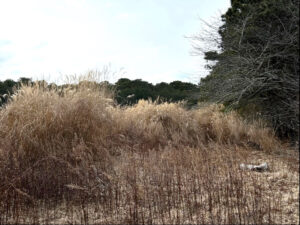
The MA Invasive Plant Advisory Group (MIPAG) reviewed the species and listed it as invasive in 2024. Key criteria for designating a plant as invasive includes having the biological potential for rapid dispersion and establishment in minimally managed habitats, dispersing over spatial gaps and potential for existing in high numbers. Given the concern over this species, Sandplain Grassland Network team members working on Nantucket, including staff at the Nantucket Conservation Foundation and the Linda Loring Nature Foundation, compiled the information used for MIPAG to do the evaluation. The Nanahumacke Preserve on Nantucket has over 0.71 acres of dense M. sinensis growth and offered an example of an unmanaged site. Meanwhile, populations on other conservation properties on island have been managed proactively for several years as the Nantucket Invasive Plant Species Committee had identified this species as a potentially invasive plant. While many other states have designated it as an invasive species, only New York State had regulated it before its addition to the MA to its Prohibited Plant List.
Removal Recommendations: Nantucket conservation groups have had success in removing M. sinensis (typically in mid-summer to fall) with clipping off seed heads and giving the foliage a crew cut, then digging up the root ball with a sharp, deep spade called a “Root Slayer”. They then flip it over in place, so the roots dry and freeze over the winter composting in place. This kills the plant 99% of the time, however, surveys are needed for new seedlings and sprouts the next year. If plants have rhizomes spreading out from established plants rather than in distinct clumps, they are more likely to be M. sacchariflorus or a hybrid and those species may be harder to remove with digging. (Note : M. sacchariflorus and its hybrids have already been included in the MA Prohibited Plants list, prior to listing of M. sinensis.) If M. sinensis is not able to be removed right away, cutting and removing seed heads each season can prevent spread, and can enable large infestations to be removed in stages.
—Karen Lombard

Photos of dense stands of M. sinensis from Nanahumacke Preserve, Nantucket, MA in January of 2025.
Photos: Sarah Bois.